
AI-Ready Data: Why Enterprise AI Pilots Fail in Production
Ready to transform your data strategy with cutting-edge solutions?
- 89% of enterprise AI pilots never reach production. Data integration, governance gaps, and silos are why. See how Snowflake Cortex AI fixes the root cause.
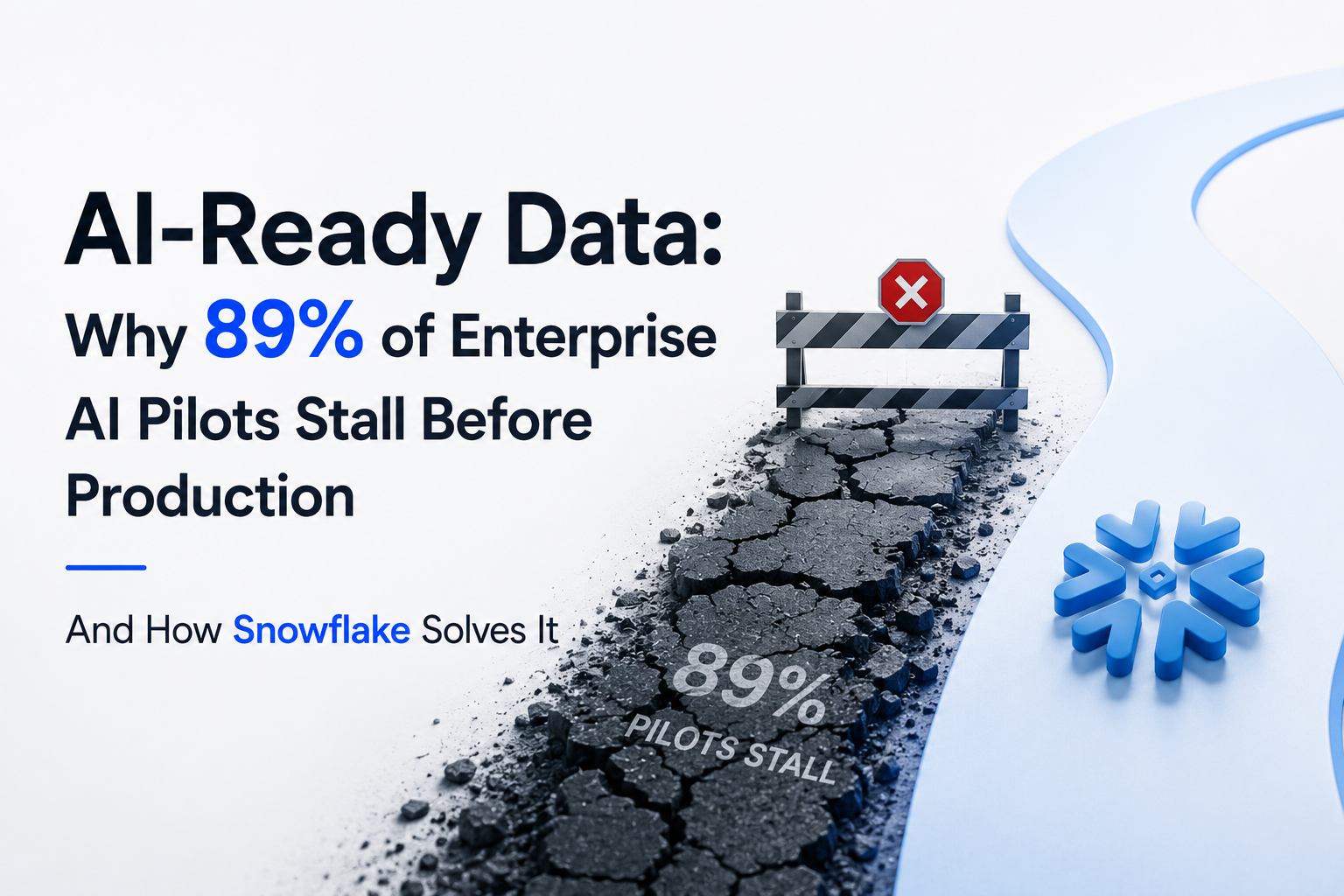
AI-Ready Data: Why 89% of Enterprise AI Pilots Stall Before Production and How Snowflake Solves It
AI-ready data is enterprise data that has been organized, governed, and made structurally accessible for production AI inference, not just controlled pilot experimentation.
A February - March 2026 survey of 650 enterprise technology leaders found that 89% of the failures stopping AI pilots from reaching production are traceable to five specific root causes, with data integration complexity ranking first at 63%. Snowflake’s own enterprise AI research found that only 7% of organizations have the majority of their unstructured data in an AI-ready state, explaining why pilots succeed under curated conditions and break the moment production data arrives.
Topics covered: AI-ready data, pilot-to-production gap, data governance, Snowflake Cortex AI, LLMOps, model drift.
The typical enterprise AI pilot is built on borrowed conditions. A team selects a manageable slice of data, pre-cleans it, limits the user base, and manually reviews model outputs before each stakeholder review. The model performs well. The pilot passes its success criteria. Then the system moves to production and meets real enterprise data for the first time.
Only 14% of enterprises with active AI agent pilots have reached production scale, according to a February - March 2026 survey of 650 enterprise technology leaders (Digital Applied, 2026). The 86% that stall are not failing because their models are poorly designed. They are failing because the data environment that made the pilot look successful does not exist in production.
AI-ready data is the specific gap at the center of this problem. The organizations that close the pilot-to-production gap fastest are not building better models. They are building data environments where models do not need better conditions to perform.
Most AI pilots succeed on data conditions that production cannot replicate
The data environment inside a typical AI pilot is carefully managed and largely artificial. Teams curate representative samples, resolve edge cases by hand, and operate from a single controlled data source. These conditions produce high pilot accuracy scores. They are not production conditions.
Snowflake’s enterprise AI research quantifies how wide this gap actually is. Across organizations surveyed: 96% face significant challenges when scaling AI, 65% struggle to break down data silos, 62% find it difficult to measure data quality, and just 7% say the majority of their unstructured data is in an AI-ready state. The 7% figure is the most instructive: the problem is not that organizations lack data. It is that they lack data in the structural state production AI requires.
Gartner estimates that 85% of all AI projects fail because of poor data quality, cited by Astrafy in November 2025. But the more precise diagnosis is that production AI systems encounter data from ERP systems, CRMs, cloud object stores, and real-time event streams - each with different schemas, update frequencies, and access controls - none of which was part of the pilot environment. The pilot was tested on data that does not exist in production at that level of cleanliness or structure.
Why do AI pilots succeed in development but fail in production?
AI pilots succeed in development because teams use curated, clean, and bounded datasets under controlled conditions. In production, the same model encounters live, fragmented, multi-source enterprise data that was never part of the pilot, causing accuracy and reliability to degrade in ways that manual pilot testing could not predict.
Five gaps account for 89% of the failures that keep pilots from scaling
The causes of pilot failure are not random; they cluster around five identifiable gaps. A February - March 2026 survey of 650 enterprise technology leaders by Digital Applied found that 89% of measured production failures among AI pilots are traceable to five root causes.
| Root cause | Share of respondents citing this gap | Primary mechanism |
|---|---|---|
| Integration complexity | 63% | AI systems cannot connect to live enterprise data at inference time |
| Output quality at volume | 58% | Model degrades when input distributions differ from training data |
| Monitoring and observability deficit | 54% | Teams cannot detect performance drift after launch |
| Organizational ownership gap | 49% | No clear owner for AI behavior post-launch; degradation goes unnoticed |
| Domain-specific training data | 41% | Model was not trained on the actual data the production task requires |
Source: Digital Applied survey of 650 enterprise technology leaders, March 2026.
Four of the five gaps are directly data-related. Integration complexity means AI systems cannot reach the data they need when they need it. Output quality at volume means the model was not prepared for the full distribution of production inputs. Monitoring deficit means teams have no data infrastructure to track when model performance starts to slip. Domain-specific training data means the model was trained on a curated sample that does not represent what it will encounter at scale.
Organizational ownership appears to be a people problem rather than a data problem. The Digital Applied survey found, however, that organizations without dedicated operational ownership were six times more likely to experience production incidents requiring rollback, and the majority of those incidents were triggered by undetected data failures.
These gaps do not arrive in sequence. A team blocked on integration complexity never reaches an output quality failure. A team that cannot monitor production outputs cannot detect training data mismatches. Each gap generates the next one.
What are the most common reasons AI pilots fail to reach production?
The five most frequently cited failure causes are integration complexity (63%), output quality degradation at scale (58%), insufficient monitoring infrastructure (54%), unclear organizational ownership (49%), and domain-specific training data gaps (41%), according to a Digital Applied survey of 650 enterprise technology leaders (March 2026).
AI-ready data is an architectural requirement, not a data cleanup task
AI-ready data is enterprise data that has been made structurally accessible across sources, semantically defined through a governed metadata layer, formatted for production AI inference at scale, and auditable under applicable compliance requirements including GDPR Article 22 and the EU AI Act for high-risk systems.
Most organizations conflate data quality with data readiness, and the distinction is critical. A dataset with no duplicate records and no missing fields is clean. It is not AI-ready if the AI system cannot reach it in real time, cannot trace its lineage under a regulatory audit, or cannot ingest it consistently as source schemas change.
The structural differences between a pilot data environment and a production data environment are specific and, importantly, predictable in advance.
| Dimension | Pilot environment | Production environment |
|---|---|---|
| Data state | Static, curated sample | Live, multi-source, continuously updating |
| Data coverage | Controlled representative slice | Full input distribution, including edge cases |
| Access control | Single team, minimal restrictions | Role-based, compliance-enforced across functions |
| Governance | Minimal or manual | Audit trails and lineage tracking required |
| Update cadence | Reporting timescale (quarterly or annual) | Near real-time monitoring, often hourly |
| Model relationship | Static artifact tested against a fixed dataset | Living system that degrades as input data changes |
| Error handling | Manual intervention acceptable | Fully automated; no human review per inference step |
| Infrastructure | Laptop or single API endpoint | CI/CD pipelines, Kubernetes, distributed cloud infrastructure |
Sources: ClarityArc Consulting (May 2026); First Line Software (February 2026); Prediction Guard (May 2026); HST Solutions (March 2026).
Two of these differences carry the most production risk. First, update cadence: pilots assume data is reviewed periodically; production requires continuous verification, often hourly. Second, model state: in a pilot, the model is a finished artifact; in production, it is a living system that degrades as the data it depends on shifts over time (ClarityArc Consulting, May 2026).
The financial cost of this mismatch is documented. Large language model hallucinations, which are disproportionately caused by retrieval of inconsistent or undocumented production data, cost organizations an estimated $67.4 billion in losses during 2024, according to a 2025 study cited by OneReach.ai.
The governance layer adds a further complication specific to generative AI. Atlan’s data governance research (Emily Winks, May 2026) found that without a governed data catalog, LLMs retrieve semantically inconsistent documents that produce subtly wrong outputs - errors that are impossible to debug without full data lineage traceability. This failure mode does not appear in pilots because pilots operate on curated data with known contents.
What is the difference between data quality and AI-ready data?
Data quality refers to the accuracy and completeness of individual records. AI-ready data is an architectural state that includes quality but also requires real-time accessibility, semantic governance across sources, compliance auditability, and structural compatibility with production AI inference patterns at enterprise scale.
How Snowflake addresses the AI-ready data gap
Snowflake Cortex AI is a suite of AI capabilities built natively into the Snowflake Data Cloud that allows organizations to run large language model inference, document processing, semantic search, and structured data retrieval directly on governed enterprise data, without moving that data out of the platform to a separate AI environment.
The architectural premise is specific: the most reliable way to close the pilot-to-production data gap is to run AI on the governed data rather than on a copy. Every additional data movement between a source system and an AI inference environment introduces a governance gap, a latency cost, and a synchronization risk. Snowflake’s Cortex AI functions operate on data that remains within the organization’s governed Snowflake environment.
What does Snowflake Cortex AISQL do?
Snowflake Cortex AISQL is a set of multimodal pipeline functions - AI_COMPLETE, AI_TRANSCRIBE, AI_CLASSIFY, AI_PARSE_DOC, and AI_EXTRACT - that run AI operations directly on Snowflake-governed data, with embedded cost governance controls and support for continuous updates through Dynamic Tables.
Cortex AISQL delivers query runtime 3 to 7 times faster than manual AI pipelines, based on similarly-sized models in proof-of-concept comparisons (Snowflake, November 2025). Snowflake’s Online Feature Store supports sub-50 millisecond prediction latency, meeting the sub-100 millisecond latency requirement for customer-facing production AI systems.
What does Snowflake’s production AI governance look like in practice?
The Snowflake platform integrates cost governance and role-based access enforcement directly into AI inference operations. Organizations do not need to build a separate compliance layer alongside production AI; governance requirements are enforced at the data layer, where the model operates. Snowflake also connects to more than 19 external AI-ready data providers - covering financial data, clinical research, and media content - allowing production AI systems to operate on a combination of internal enterprise data and verified external sources within the same governed environment (Snowflake, November 2025).
The enterprise case for this architecture is supported by documented outcomes. Eaton, a global power management company, replaced a custom AI implementation built on a separate platform with Snowflake’s AISQL approach. The result was a 900% improvement in processing time and approximately $500,000 in estimated annual savings versus the custom build. The prototype was delivered in days (Snowflake, November 2025).
Allegis Group used Snowflake’s Document AI capabilities to process more than 150,000 documents in a contract lifecycle management migration, saving tens of thousands of manual hours that would otherwise have required human review (Snowflake, November 2025).
How does Snowflake address the LLMOps maturity gap?
LLMOps - the operational discipline governing large language models in production - is approximately 3 to 4 years behind traditional MLOps in governance maturity, according to Atlan research (Emily Winks, May 2026). The failure modes are also different: where traditional ML models fail from data drift and training bugs, LLMs fail from hallucinations, prompt injection, context window overflow, and cost overruns from untracked inference volume.
Snowflake’s platform addresses this through native experiment tracking, model versioning support, and Cortex Agents that orchestrate both structured and unstructured data retrieval within the same governed environment. The Snowflake Managed MCP server enables connectivity to external systems without requiring data to leave the governed perimeter - a specific requirement for organizations operating under GDPR data residency rules or EU AI Act high-risk system documentation standards.
What does Snowflake Cortex AI do for enterprise AI production?
Snowflake Cortex AI runs large language model inference and document processing directly on governed enterprise data inside the Snowflake Data Cloud, delivering 3 to 7 times faster query runtime than manual AI pipelines, sub-50 millisecond prediction latency for real-time applications, and built-in cost governance and access controls, without requiring a separate AI environment or compliance system.
The organizations closing the gap are fixing data infrastructure first, not the model
The production cost evidence clarifies the priority. A typical proof-of-concept costs €15,000 to €40,000 in Year 1. A production deployment costs €160,000 to €390,000, a 10 to 20 times increase, according to HST Solutions research reviewed by Arwa Bhai (March 2026). The multiplier includes €60,000 to €150,000 in ML engineering, €40,000 to €80,000 in data engineering, and €20,000 to €50,000 in compliance implementation.
The organizations that reduce this cost multiplier are not negotiating better model licenses. They are building their data infrastructure to production standard before the first pilot is launched. The cost of fixing data architecture after a failed pilot is higher than the cost of building it correctly before the pilot begins.
Snowflake’s research found that 92% of early AI adopters report positive ROI, with returns of approximately $1.49 for every $1 invested in AI. The pattern among early adopters is consistent: they addressed data readiness, governance, and accessibility before scaling AI workloads, not after a pilot stalled.
The monitoring evidence reinforces the same point. AI/ML monitoring usage in production climbed from 42% in 2024 to 54% in 2025 (Digital Applied, March 2026). The increase reflects a shift in how enterprises approach production readiness: monitoring is no longer treated as a post-deployment consideration but as a precondition for going live at all. Organizations that adopt MLOps practices reduce model deployment time by 40%, according to Gartner, cited by ClarityArc Consulting (May 2026).
How much does it cost to move an AI pilot to production?
A typical AI proof-of-concept costs €15,000 to €40,000 in Year 1 and takes 4 to 12 weeks. A production deployment of the same system costs €160,000 to €390,000 and takes 6 to 18 months from the proof-of-concept stage, representing a 10 to 20 times cost increase driven by ML engineering, data infrastructure, compliance, and ongoing operational requirements, according to HST Solutions research (March 2026).
The pilot tests the model; production tests the data infrastructure
An AI pilot does not test whether the model works. It tests whether the team can curate ideal conditions. A production deployment tests whether the data infrastructure can sustain a model at enterprise scale, under real input distributions, with no manual intervention, while remaining compliant with applicable frameworks.
The five gaps that account for 89% of production failures all reduce to a single underlying condition: the data environment a pilot depends on does not exist in production, and no model update changes that. What changes it is data architecture - unified, governed, and accessible at inference time.
Snowflake’s approach of running AI directly on governed, production-standard data removes the most predictable failure mode before it can occur. The 62% of organizations that say they struggle to prepare AI-ready data already know what the gap is. The organizations that close it are the ones that treat data readiness as a precondition for AI production, not a problem to solve after the pilot stalls.
Quick reference glossary
AI-ready data - Enterprise data that has been made structurally accessible, semantically governed, and formatted for production AI inference at scale, not just for controlled pilot experimentation.
Pilot-to-production gap - The documented pattern in which AI systems that succeed in controlled pilot conditions fail or stall when deployed to production environments that use live, fragmented, and inconsistently governed enterprise data.
Snowflake Cortex AI - A suite of AI capabilities built natively into the Snowflake Data Cloud that runs large language model inference, document processing, and structured retrieval directly on governed Snowflake data, without requiring data movement to a separate AI environment.
Cortex AISQL - A set of multimodal AI pipeline functions inside Snowflake (AI_COMPLETE, AI_TRANSCRIBE, AI_CLASSIFY, AI_PARSE_DOC, AI_EXTRACT) that perform AI operations on Snowflake-governed data with embedded cost controls and continuous update support.
LLMOps - The operational discipline governing large language models in production, covering prompt management, evaluation, deployment, cost monitoring, hallucination detection, and governance; currently 3 to 4 years behind traditional MLOps in maturity.
Model drift - The degradation of a production AI model’s performance over time as the distribution of real-world input data diverges from the data the model was trained and tested on.
Data silo - An isolated data store within an organization that is not accessible to other systems or teams, a primary structural barrier to AI-ready data at enterprise scale.
Feature store - A centralized data infrastructure component that prepares, stores, and serves the specific data features production ML models need at inference time, bridging the gap between data engineering and AI deployment.
Data governance - The policies, processes, and technical controls that define who can access which data, how it can be used, and how its lineage and quality are tracked, a mandatory component of production AI that is typically absent from pilot environments.
You Might Also Like
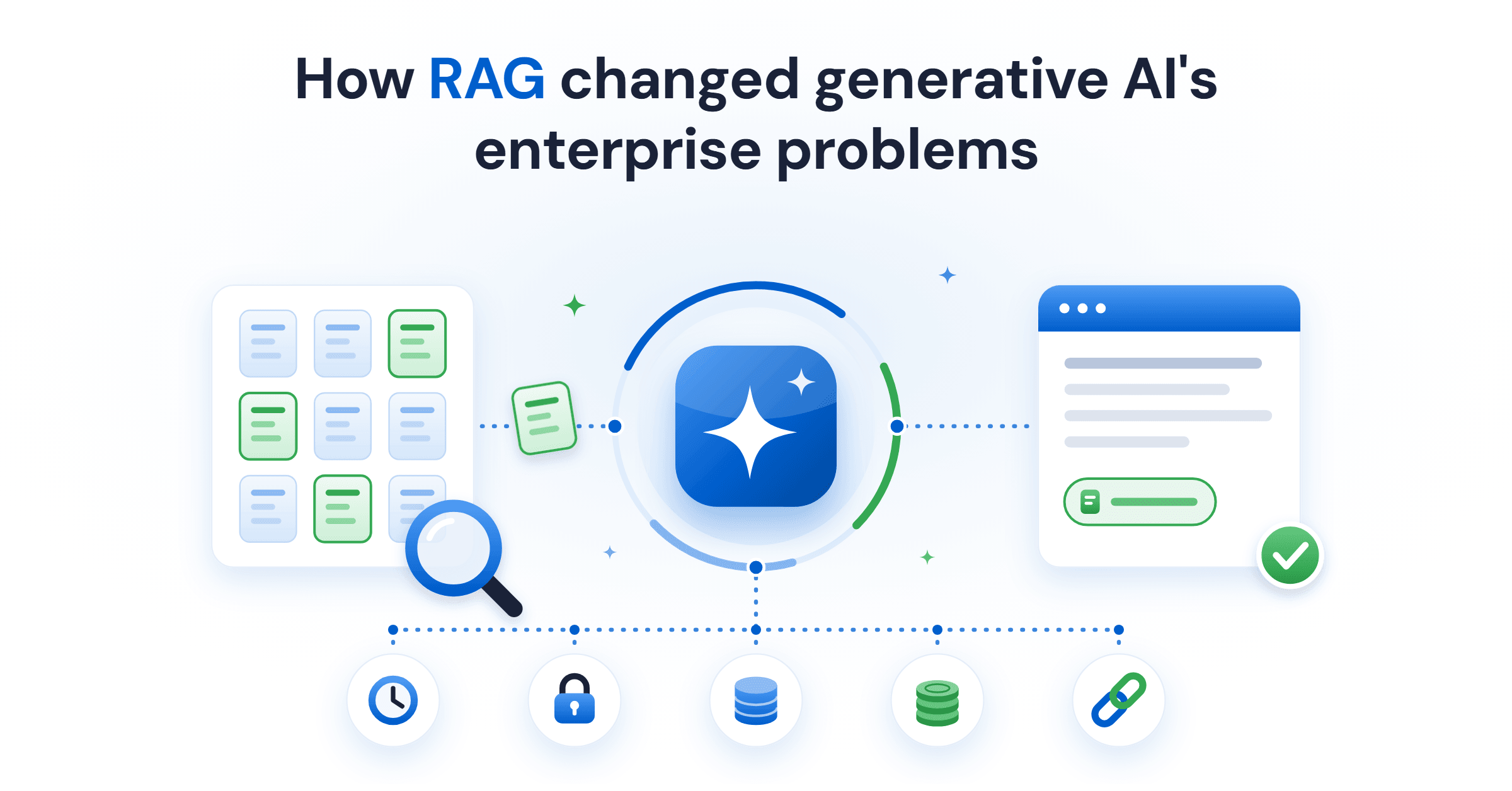
Retrieval-augmented generation (RAG) gives a language model current and private data at query time. What it fixes, what it costs, and the five ways it fails.
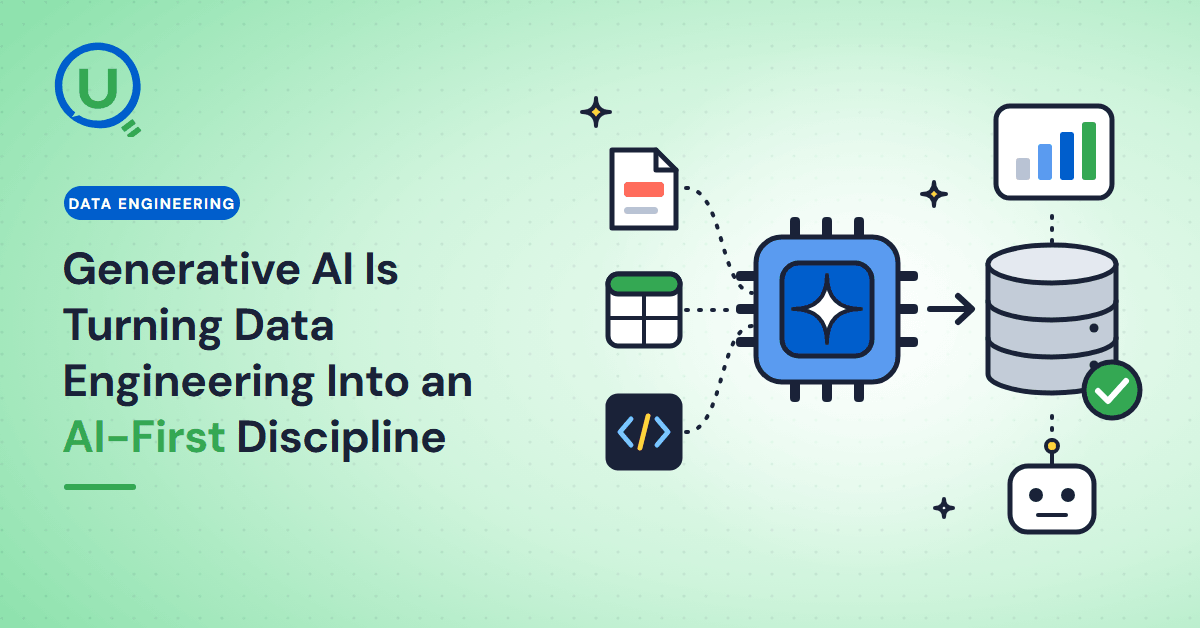
Generative AI in data engineering: what Gartner's Data Engineering 2.0 means, how AI agents now write pipeline code, and why data engineers matter more.
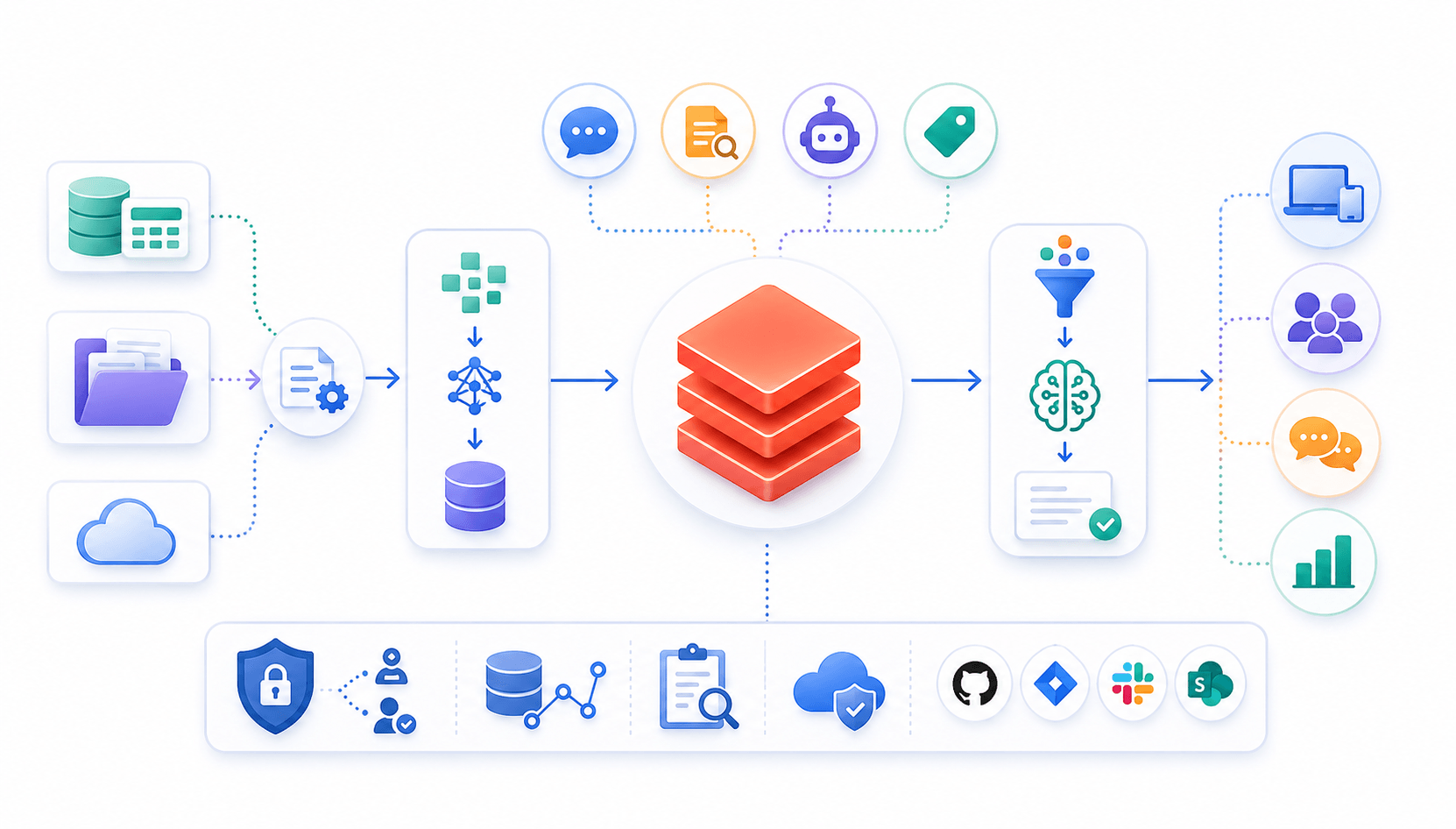
Learn to build governed RAG pipelines on Databricks using Agent Bricks and Unity Catalog. Discover the Knowledge Assistant, its 70% quality boost, and key limits.

Storage account keys and mount points give every user in a Databricks workspace the same shared access to ADLS, with no audit trail. Here's why teams are moving to Storage Credentials and External Locations instead.
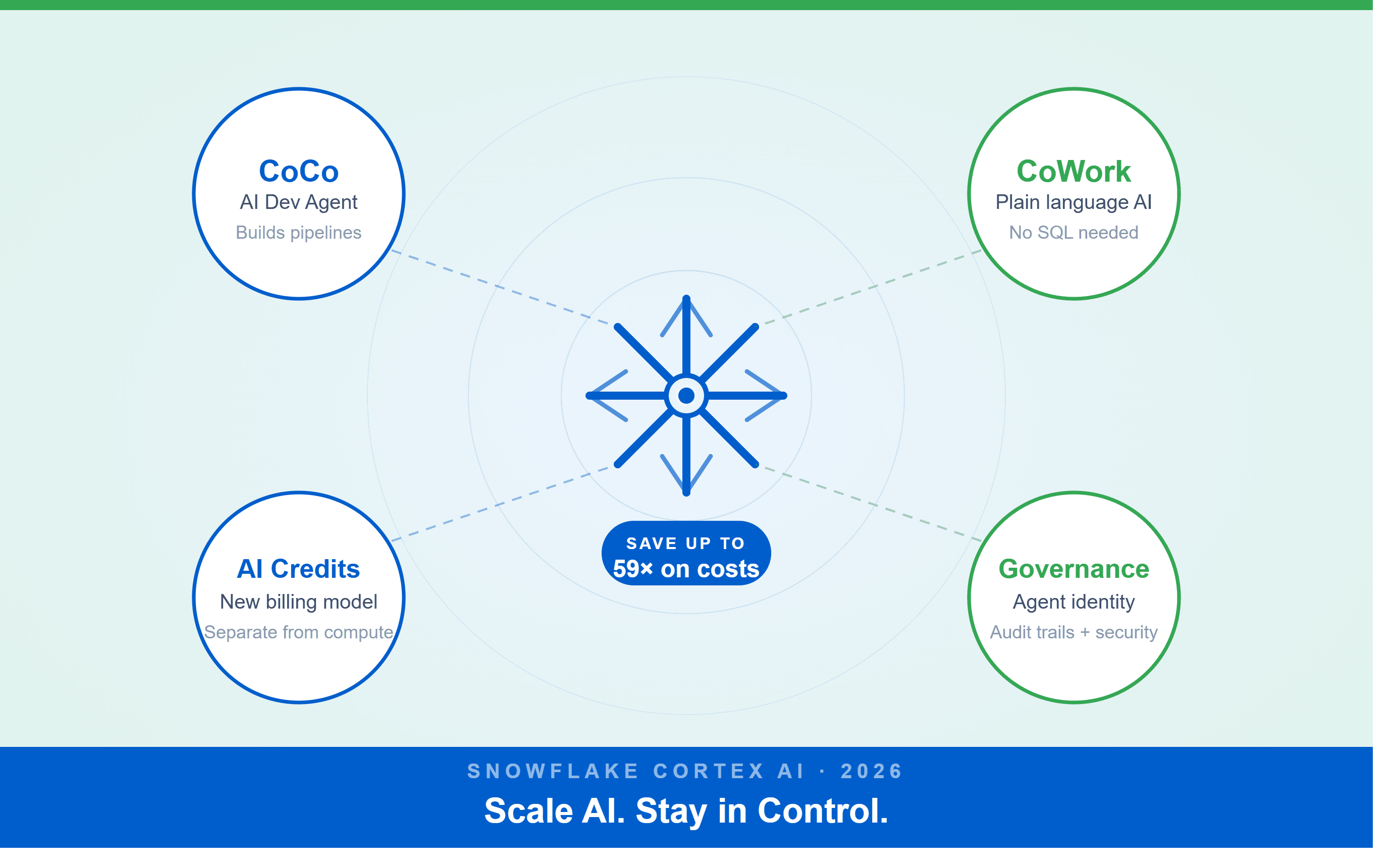
A Snowflake Summit 2026 benchmark revealed a 59x cost gap — open-source models at 440 credits vs. frontier models at 26,000 credits for identical workloads. Learn how CoCo, CoWork, AI Credits, and Cortex Training change enterprise AI strategy.
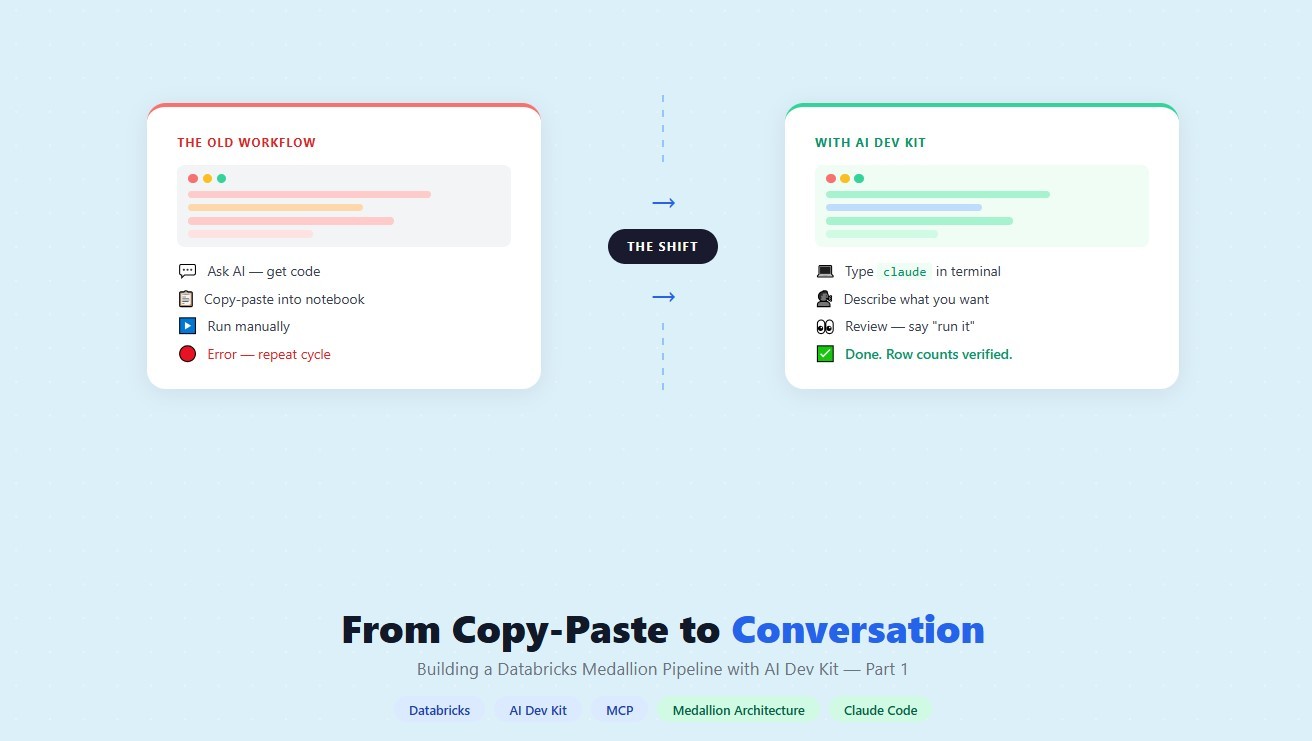
How a data engineering team replaced manual pipeline work with natural language prompts, using Claude Code and the Databricks AI Dev Kit.
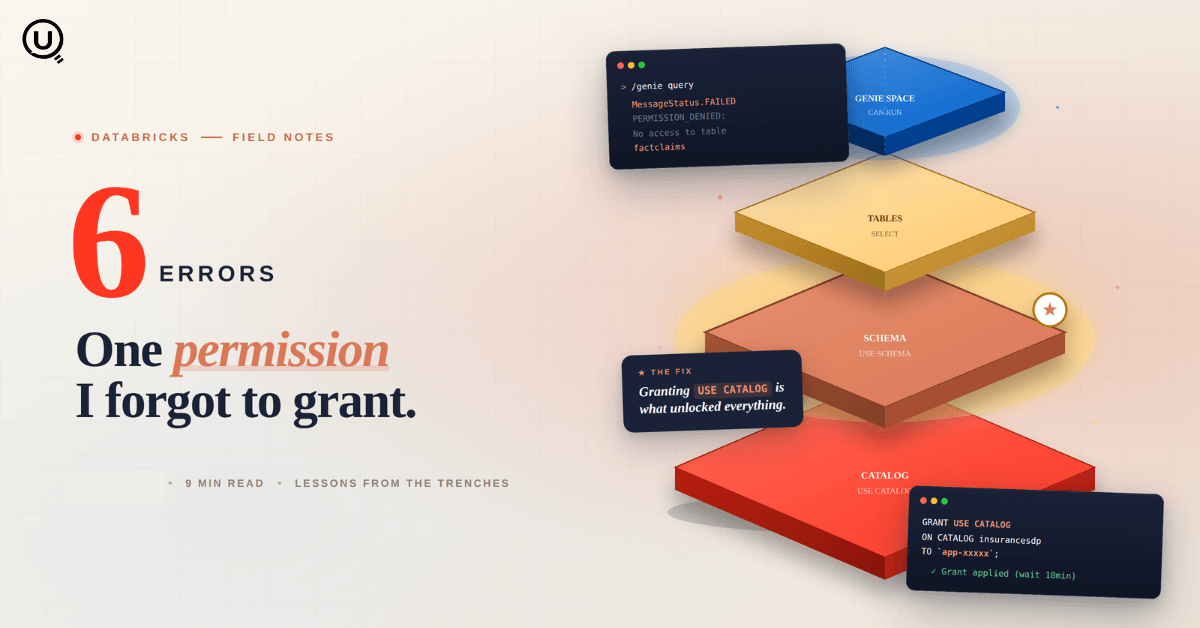
Six errors, 6 hours of debugging, and the permission checklist that finally made Databricks Apps + Genie work. The full lessons-learned guide.
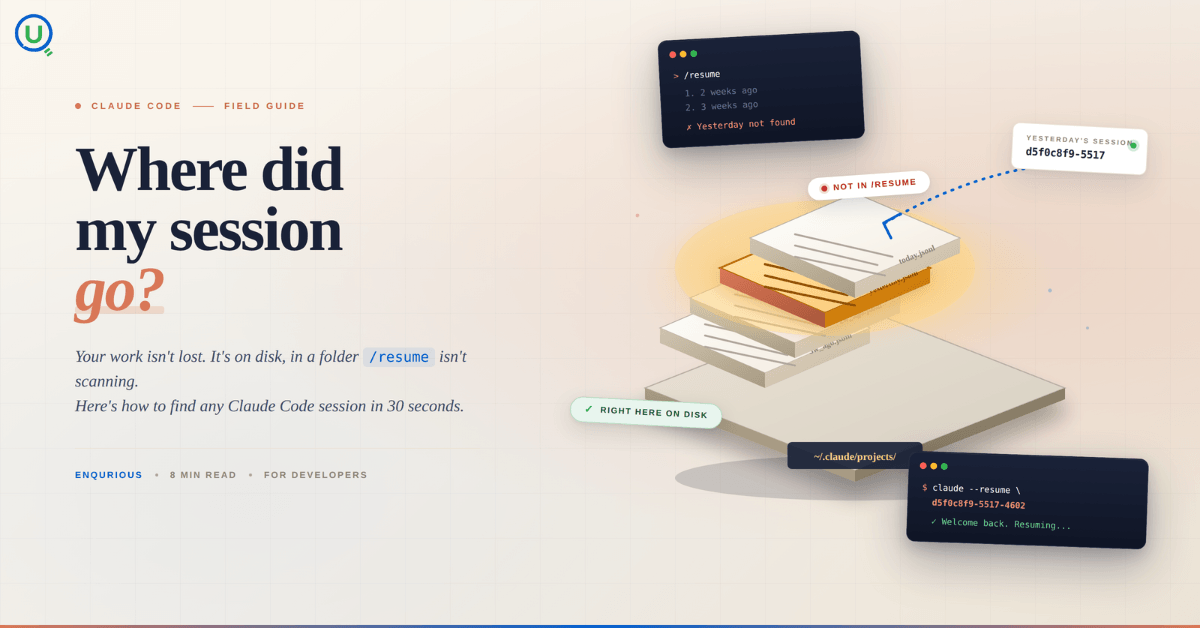
Your Claude Code session isn't lost. It's on disk, in a folder /resume isn't scanning. Here's how to find any session in 30 seconds, with the exact commands.
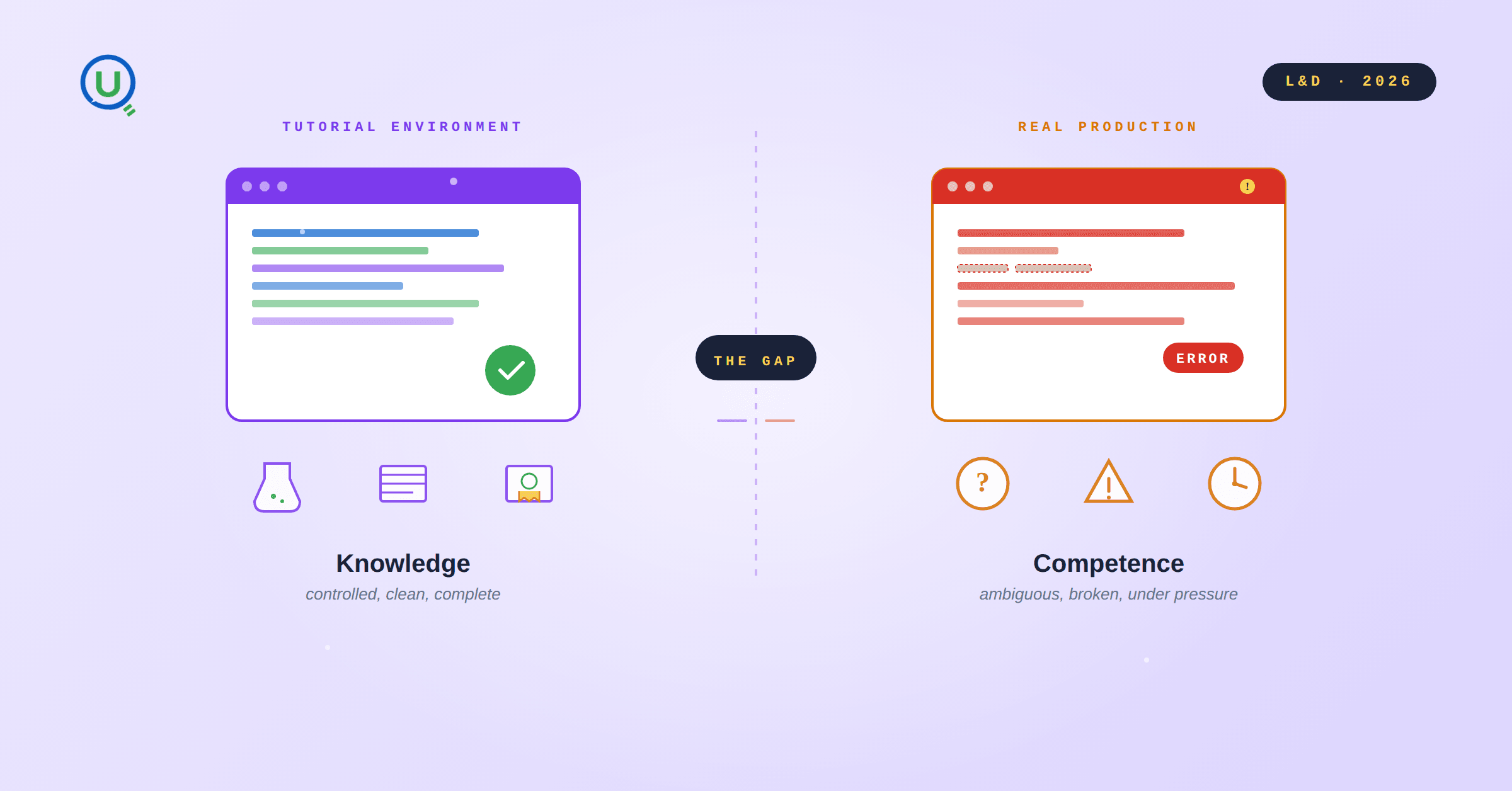
Scenario based learning replaces tutorials with realistic operational scenarios where engineers develop the hands on judgment classroom instruction cannot produce. How it works and why it matters.
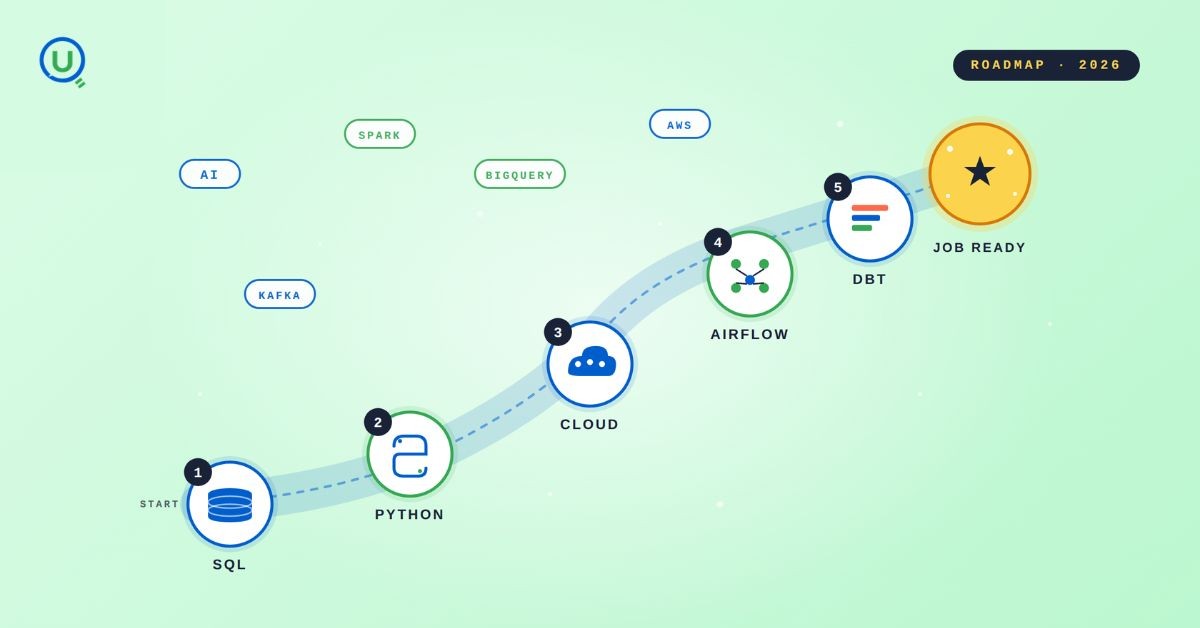
The 2026 data engineering roadmap. SQL, Python, cloud, Airflow, dbt, streaming. What companies actually hire for and how to build a portfolio that gets shortlisted.

Medallion Architecture splits your data pipeline into Bronze, Silver, and Gold layers so a small business change never forces a full rebuild. Here's why it works.

I was working on a large content repository on Windows, and I needed to version some new work — campaign assets, workshop content, LinkedIn job descriptions, and some file deletions. Simple enough, right? What followed was a two-day journey through some of Git's more obscure corners.
New engineers shouldn't learn Docker like they're defusing a bomb. Here's how we created a fear-free learning environment—and cut training time in half." (165 characters)

A complete beginner’s guide to data quality, covering key challenges, real-world examples, and best practices for building trustworthy data.
Explore the power of Databricks Lakehouse, Delta tables, and modern data engineering practices to build reliable, scalable, and high-quality data pipelines."
A real-world Terraform war story where a “simple” Azure SQL deployment spirals into seven hard-earned lessons, covering deprecated providers, breaking changes, hidden Azure policies, and why cloud tutorials age fast. A practical, honest read for anyone learning Infrastructure as Code the hard way.
Data doesn’t wait - and neither should your insights. This blog breaks down streaming vs batch processing and shows, step by step, how to process real-time data using Azure Databricks.

This blog talks about Databricks’ Unity Catalog upgrades -like Governed Tags, Automated Data Classification, and ABAC which make data governance smarter, faster, and more automated.

Tired of boring images? Meet the 'Jai & Veeru' of AI! See how combining Claude and Nano Banana Pro creates mind-blowing results for comics, diagrams, and more.

What I thought would be a simple RBAC implementation turned into a comprehensive lesson in Kubernetes deployment. Part 1: Fixing three critical deployment errors. Part 2: Implementing namespace-scoped RBAC security. Real terminal outputs and lessons learned included
This blog walks you through how Databricks Connect completely transforms PySpark development workflow by letting us run Databricks-backed Spark code directly from your local IDE. From setup to debugging to best practices this Blog covers it all.

A simple ETL job broke into a 5-hour Kubernetes DNS nightmare. This blog walks through the symptoms, the chase, and the surprisingly simple fix.
Master the bronze layer foundation of medallion architecture with COPY INTO - the command that handles incremental ingestion and schema evolution automatically. No more duplicate data, no more broken pipelines when new columns arrive. Your complete guide to production-ready raw data ingestion

This blog talks about the Power Law statistical distribution and how it explains content virality

This blog explains how Apache Airflow orchestrates tasks like a conductor leading an orchestra, ensuring smooth and efficient workflow management. Using a fun Romeo and Juliet analogy, it shows how Airflow handles timing, dependencies, and errors.

The blog contains the journey of ChatGPT, and what are the limitations of ChatGPT, due to which Langchain came into the picture to overcome the limitations and help us to create applications that can solve our real-time queries

An account of experience gained by Enqurious team as a result of guiding our key clients in achieving a 100% success rate at certifications

This blog delves into the capabilities of Calendar Events Automation using App Script.
Dive into the fundamental concepts and phases of ETL, learning how to extract valuable data, transform it into actionable insights, and load it seamlessly into your systems.