
Generative AI Is Turning Data Engineering Into an AI-First Discipline
Ready to transform your data strategy with cutting-edge solutions?
Key takeaways
Generative AI in data engineering is the use of large language models and AI agents to build pipelines, diagnose failures, document data, and turn unstructured documents into structured tables.
Gartner's 2026 research names the shift Data Engineering 2.0, built on agentic automation, context engineering, retrieval-augmented generation, and unstructured data.
Google Cloud's Data Engineering Agent is generally available and turns natural-language requirements into SQL or Python, identifies pipeline failures, and recommends schema and partitioning improvements.
Databricks adds natural-language transformation through Lakeflow Designer, plus ai_extract and ai_classify for pulling structured fields out of unstructured documents inside a pipeline.
The data engineer moves from writing every line of code to defining requirements, reviewing the generated implementation, and governing data that both people and AI agents consume.
Generative AI in data engineering is the application of large language models and AI agents to the core tasks of the discipline: building pipelines, transforming data, troubleshooting failures, documenting datasets, and processing unstructured information such as PDFs, emails, and contracts.
The role is not disappearing; it is being redefined. Data engineering was largely a pipeline-centric craft: write the extract, write the transform, write the load, keep the warehouse running. Gartner's 2026 research describes the shift underway as Data Engineering 2.0, an era defined by agentic automation, context engineering, retrieval-augmented generation, and unstructured data as core components of an AI-first data platform. Google Cloud has already made this concrete with a generally available Data Engineering Agent that translates natural-language requirements into SQL or Python, identifies pipeline failures, suggests fixes, and recommends schema and partitioning improvements. Databricks has moved in the same direction, adding natural-language transformation through Lakeflow Designer, AI-assisted engineering through Genie Code, agentic SQL conversion, and AI functions that extract and classify information from unstructured data.
Generative AI replaces hand-written pipeline code with natural-language requirements
AI-assisted pipeline development is the practice of describing a data transformation in plain language and having an AI agent generate the SQL, Python, or pipeline configuration that implements it, rather than a data engineer writing every line by hand.
A requirement such as "load customer transaction data, remove duplicates, standardize customer IDs, validate the transaction amount, and create a daily aggregated table" can now be converted directly into working code by AI-assisted engineering tools. This does not remove the data engineer from the loop. It moves the engineer from writing every line of code to defining requirements, reviewing the generated implementation, testing it, governing it, and optimizing it. That is a change in where the engineer's time goes, not a reduction in how much the role matters.
What is a data engineering agent?
A data engineering agent is an AI system built into a data platform that can generate pipeline code, diagnose why a pipeline failed, suggest schema or partitioning improvements, and iteratively fix errors, rather than only completing code a developer is already typing. Google Cloud's Data Engineering Agent does exactly this: it is generally available and generates SQL and Python from natural-language requirements, flags pipeline failures, and recommends fixes. Databricks' agentic SQL converter performs a related task, analyzing legacy SQL, understanding its semantic intent, validating the converted SQL, and iteratively correcting errors until the conversion passes.
Development step | Before generative AI | With an AI agent |
|---|---|---|
Writing the pipeline | Data engineer writes SQL, Python, or Spark code line by line | Engineer states the requirement in natural language; the agent drafts the implementation |
Diagnosing a failure | Engineer traces logs and stack traces manually | Agent identifies the failure point and proposes a fix |
Improving performance | Engineer profiles the job and redesigns schema or partitioning by hand | Agent recommends schema and partitioning changes based on observed query patterns |
Does an AI pipeline agent replace the data engineer?
No. It replaces the manual writing of every line of pipeline code, but the data engineer remains responsible for defining the requirement correctly, reviewing what the agent generates, testing it, and governing how it runs in production.
Unstructured data becomes a first-class data engineering problem
Traditional data engineering worked almost entirely on structured data: tables, rows, columns, JSON and relational databases. Unstructured data, such as PDFs, emails, contracts, images, audio, video, and customer conversations, sat outside that scope because it could not be queried or transformed with SQL. Generative AI removes that boundary, because large language models can read a document, extract the fields that matter, and hand back a structured record.
BigQuery has expanded its AI functions so engineers can call generative AI and embedding capabilities directly from SQL, including processing text, images, video, audio, and documents. Databricks has added functions such as ai_extract and ai_classify for pulling structured fields out of unstructured content and classifying it, both callable inside a standard data pipeline.
What do ai_extract and ai_classify do?
ai_extract is a Databricks SQL function that pulls named fields, such as a customer name, contract value, or renewal date, out of an unstructured document and returns them as structured columns. ai_classify is the companion function that assigns unstructured content, such as a support ticket or a contract clause, to a predefined category. Together they let a data engineer treat a folder of PDF contracts the same way they would treat a source table: extract, validate, load.
Why does unstructured data now belong in a data pipeline?
Because large language models can read unstructured documents and return structured fields directly inside SQL, functions such as ai_extract and ai_classify in Databricks and the multimodal AI functions in BigQuery let engineers pull contracts, emails, and support tickets into the same governed pipelines that already handle tables and JSON.
Data engineering is the foundation retrieval-augmented generation is built on
Retrieval-augmented generation (RAG) is an architecture that grounds a large language model's answers in enterprise data retrieved at query time, rather than relying only on what the model learned during training. The quality of a RAG application depends on the quality of the data pipeline feeding it, not on the model alone.
If documents are poorly extracted, chunks are badly formed, metadata is missing, or stale data enters the system, the model produces a confident answer built on a broken foundation. Good RAG starts with good data engineering, which is why data quality, metadata, lineage, chunking, embeddings, vector search, semantic layers, and governance are now part of the data engineer's job rather than a separate concern owned by an AI team.
Pipeline stage | What can go wrong | Owner |
|---|---|---|
Cleaning and chunking | Documents split at the wrong boundary, losing context | Data engineering |
Embeddings | Stale or unversioned embeddings drift from the source data | Data engineering |
Vector database | Missing metadata prevents the retriever from filtering correctly | Data engineering |
Retriever and LLM | A correct model returns a wrong answer because the retrieved context was wrong | Data engineering, upstream of the model |
Why does RAG quality depend on data engineering rather than the model?
Because a large language model can only answer as well as the context it is given: if the underlying pipeline delivers poorly chunked, stale, or unlabeled data to the retriever, the model produces a fluent but wrong answer regardless of how capable the model itself is.
AI makes data quality more important, not less
An AI agent given incorrect customer IDs, missing values, duplicate records, wrong timestamps, or inconsistent definitions does not fail loudly. It produces a fluent, confident answer built on bad data, and a reader has no obvious signal that anything went wrong. That is the central risk generative AI introduces: AI-generated intelligence is only as trustworthy as the data foundation underneath it.
This is why modern data platforms are emphasizing semantic definitions, data contracts, automated tests, lineage, and governance specifically for AI-generated workflows. dbt argues that AI-generated data models need strong contracts and tests because an agent can generate a transformation quickly without understanding every downstream dependency it touches.
Incorrect customer IDs propagate into every downstream aggregation an agent runs against them.
Missing values get silently interpolated or ignored by an agent instead of flagged.
Inconsistent definitions, such as two teams defining "revenue" differently, produce two equally confident, contradictory agent answers.
Does generative AI reduce the need for data quality work?
No, it increases it. An AI agent turns a data quality defect into a confidently stated wrong answer instead of a visible error, which is why dbt and other platform vendors are pushing data contracts and automated tests specifically for AI-generated pipelines.
Data engineers now build data for AI agents, not only for people
Data engineers previously built systems for BI dashboards, reports, data scientists, applications, and analysts, all of whom could ask a colleague when a column name was ambiguous. An AI agent cannot ask a colleague. It needs the business context built into the data itself, which is where semantic layers and context engineering become part of the job rather than an optional layer on top of it.
Raw column | What a person infers | What an agent needs stated explicitly |
|---|---|---|
customer_id | A unique customer identifier, understood from context | Defined as the unique identifier for a customer, with the join key stated |
revenue | Assumed to exclude refunds, based on team convention | Defined as recognized revenue, excluding refunds, per the finance definition |
date | Assumed to be the transaction date | Defined as the transaction settlement date, distinct from the order date |
Gartner's 2026 research names semantic context, agentic automation, and context readiness as core components of modern data engineering, precisely because an agent's answer is only as good as the metadata, permissions, lineage, and business definitions attached to the data it queries.
What does an AI agent need beyond raw tables?
An AI agent needs the data plus metadata, business context, semantic definitions, permissions, lineage and, where relevant, real-time information, because it cannot ask a colleague to clarify what a column means the way a human analyst can.
AI-first data platforms require stronger governance, not less
An AI agent that can query customer, financial, employee, sales, or healthcare data can expose that information to a user who should not have access to it if the governance layer underneath the agent is weak. More AI does not reduce the governance burden; it raises it.
Authentication and authorization control who, and which agent, can query which data.
Row-level and column-level security and data masking stop an agent from surfacing restricted fields to the wrong user.
Cataloging, lineage, and audit logs make it possible to trace what an agent queried and why.
Model governance and AI observability track how the agent itself is behaving, separately from the data it touches.
This is why modern data platforms are combining data governance and AI governance into one discipline rather than treating them as separate teams with separate tooling.
Does more AI mean less governance?
No. An AI agent that can query customer, financial, or healthcare data without row-level security, masking, and audit logging in place can expose that data to users who should never see it, which is why AI-first platforms are merging data governance and AI governance into a single discipline.
The data engineer's role is evolving from pipeline builder to AI data engineer
Traditional data engineering is not disappearing; it is becoming the foundation AI engineering is built on. The skill set is expanding rather than being replaced.
Track | What to learn |
|---|---|
Foundation | SQL, Python, data modeling, ETL and ELT, Apache Spark, data warehouses, data lakes, lakehouse architecture |
Generative AI | LLM fundamentals, prompt engineering, embeddings, vector databases, RAG, LLM APIs, evaluation |
Agentic AI | AI agents, tool calling, function calling, agent workflows, MCP, agent memory, multi-agent systems |
AI data engineering | Unstructured data processing, document intelligence, chunking, metadata engineering, semantic layers, context engineering, AI-ready pipelines |
Production | MLflow, LLM tracing, evaluation, AI observability, governance, security, cost management |
Snowflake's recent results point to the same shift at the market level: the company reports strong growth in its core data platform and attributes part of its recent growth acceleration to its AI products, alongside similar moves from Microsoft, Google Cloud, and Databricks toward the same layered architecture of AI agents and large language models sitting above a semantic layer, structured and unstructured data, and the data platform itself.
Is data engineering being replaced by AI?
No. Data engineering is becoming the foundation AI engineering is built on: the engineer moves from writing every line of pipeline code to designing AI-ready data, building RAG pipelines, managing semantic context, and implementing governance for the agents that now sit on top of the platform.
The data engineer's job is shifting from building pipelines for people to building foundations for people and agents alike
The most important change is not that generative AI writes SQL faster; it is that trusted, contextual, governed, and AI-ready data has become the thing large language models, RAG applications, and autonomous agents are built on, which makes high-quality data engineering the foundation enterprise AI depends on rather than a discipline it is replacing.
Quick reference glossary
Generative AI: AI models, typically large language models, that generate code, text, or structured data from a natural-language prompt, used in data engineering to draft pipelines, documentation, and unstructured-data extraction.
Data Engineering 2.0: Gartner's 2026 term for the shift from pipeline-centric data engineering to an AI-first discipline built on agentic automation, context engineering, RAG, and unstructured data.
Data engineering agent: An AI agent, such as Google Cloud's Data Engineering Agent, that generates pipeline code from natural language, diagnoses failures, and recommends schema or partitioning improvements.
Retrieval-augmented generation (RAG): An architecture that grounds a large language model's responses in enterprise data retrieved at query time, rather than relying solely on the model's training data.
Semantic layer: A layer of business definitions attached to raw data, such as what "revenue" or "customer" means, that lets both people and AI agents interpret a dataset consistently.
Context engineering: The practice of attaching metadata, business context, permissions, and lineage to data so an AI agent can use it correctly without a human clarifying it first.
ai_extract and ai_classify: Databricks SQL functions that pull structured fields out of unstructured documents and classify unstructured content, callable directly inside a data pipeline.
Ready to Experience the Future of Data?
You Might Also Like
Learn to build governed RAG pipelines on Databricks using Agent Bricks and Unity Catalog. Discover the Knowledge Assistant, its 70% quality boost, and key limits.

Storage account keys and mount points give every user in a Databricks workspace the same shared access to ADLS, with no audit trail. Here's why teams are moving to Storage Credentials and External Locations instead.
89% of enterprise AI pilots never reach production. Data integration, governance gaps, and silos are why. See how Snowflake Cortex AI fixes the root cause.
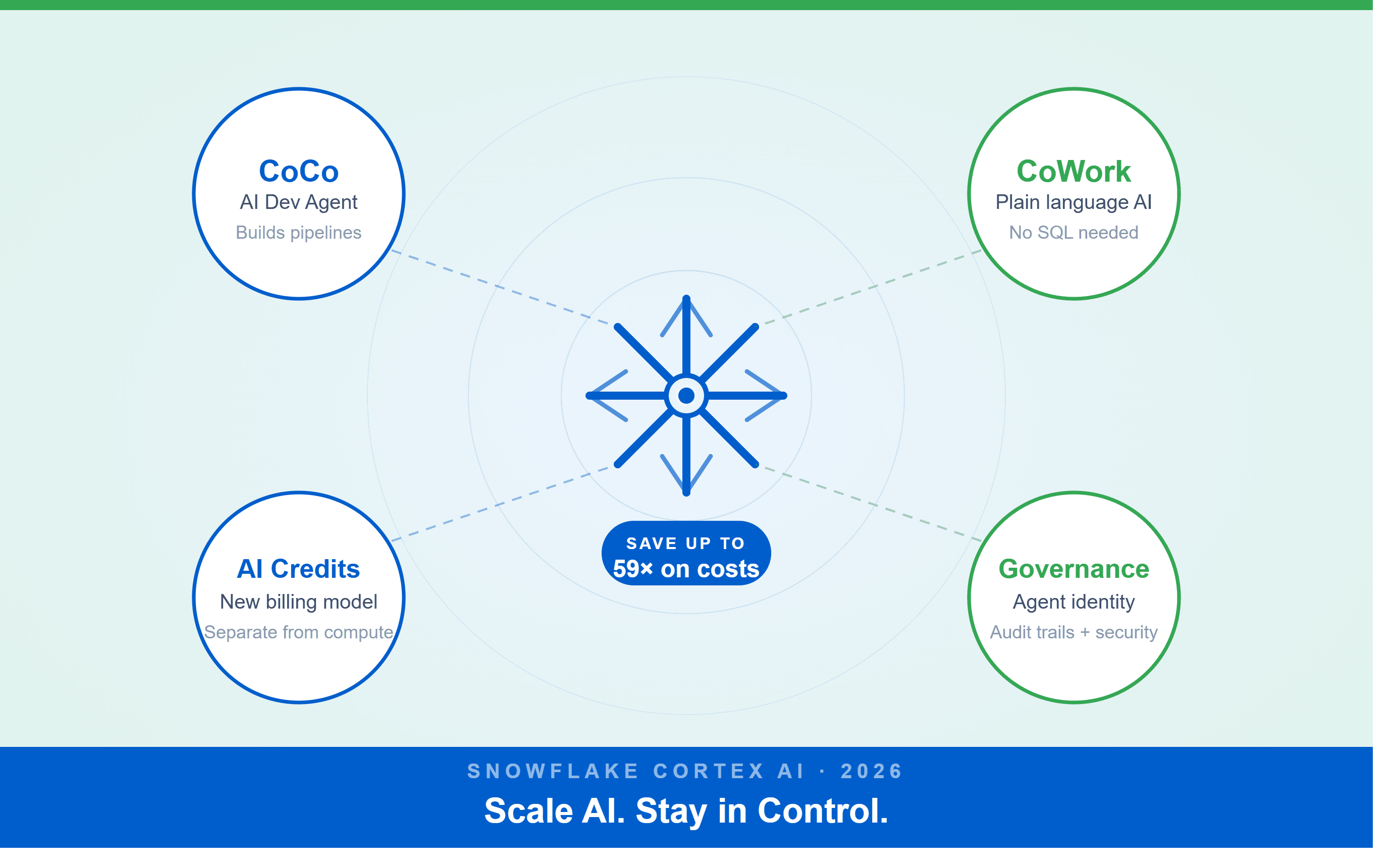
A Snowflake Summit 2026 benchmark revealed a 59x cost gap — open-source models at 440 credits vs. frontier models at 26,000 credits for identical workloads. Learn how CoCo, CoWork, AI Credits, and Cortex Training change enterprise AI strategy.
How a data engineering team replaced manual pipeline work with natural language prompts, using Claude Code and the Databricks AI Dev Kit.
Six errors, 6 hours of debugging, and the permission checklist that finally made Databricks Apps + Genie work. The full lessons-learned guide.
Your Claude Code session isn't lost. It's on disk, in a folder /resume isn't scanning. Here's how to find any session in 30 seconds, with the exact commands.
Scenario based learning replaces tutorials with realistic operational scenarios where engineers develop the hands on judgment classroom instruction cannot produce. How it works and why it matters.
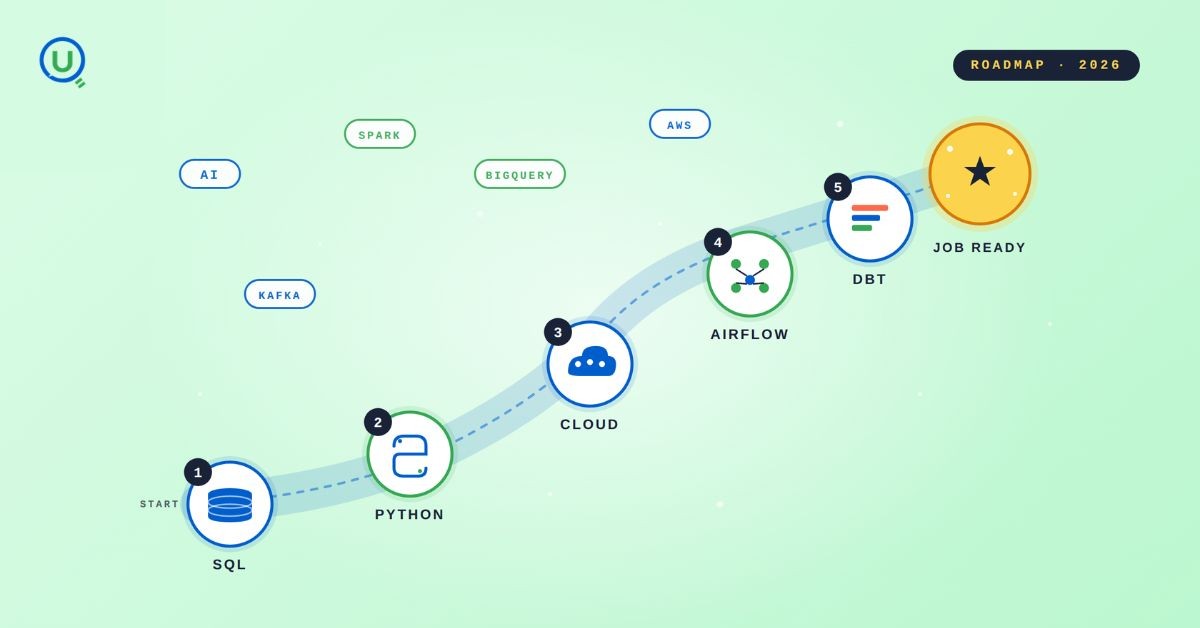
The 2026 data engineering roadmap. SQL, Python, cloud, Airflow, dbt, streaming. What companies actually hire for and how to build a portfolio that gets shortlisted.
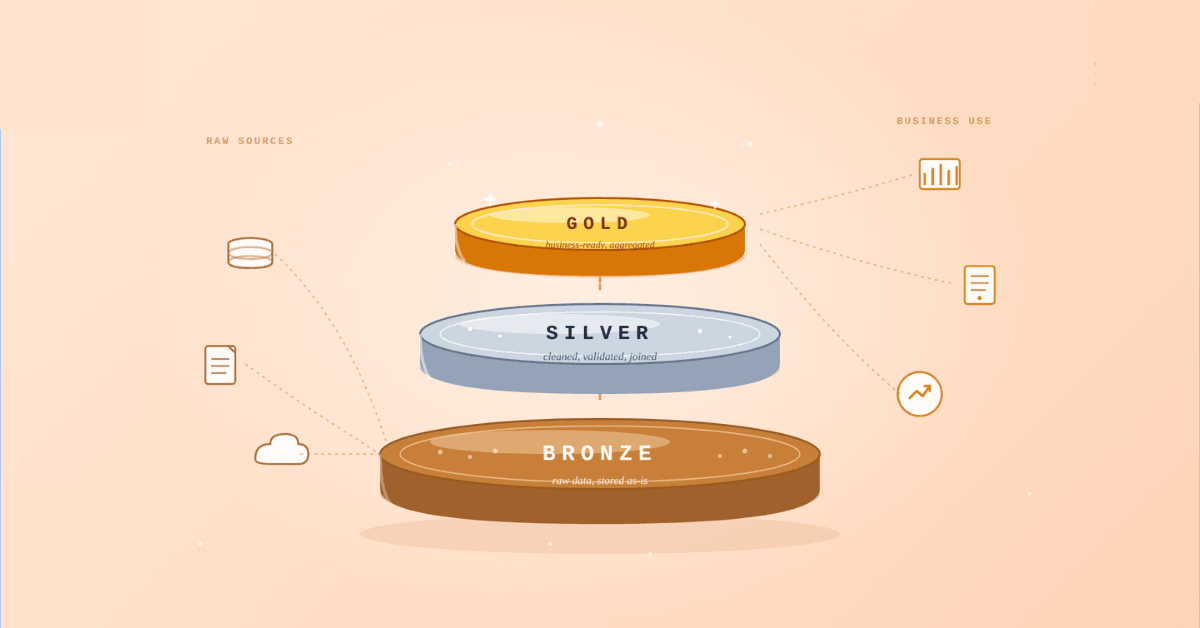
Medallion Architecture splits your data pipeline into Bronze, Silver, and Gold layers so a small business change never forces a full rebuild. Here's why it works.

I was working on a large content repository on Windows, and I needed to version some new work — campaign assets, workshop content, LinkedIn job descriptions, and some file deletions. Simple enough, right? What followed was a two-day journey through some of Git's more obscure corners.
New engineers shouldn't learn Docker like they're defusing a bomb. Here's how we created a fear-free learning environment—and cut training time in half." (165 characters)

A complete beginner’s guide to data quality, covering key challenges, real-world examples, and best practices for building trustworthy data.
Explore the power of Databricks Lakehouse, Delta tables, and modern data engineering practices to build reliable, scalable, and high-quality data pipelines."
A real-world Terraform war story where a “simple” Azure SQL deployment spirals into seven hard-earned lessons, covering deprecated providers, breaking changes, hidden Azure policies, and why cloud tutorials age fast. A practical, honest read for anyone learning Infrastructure as Code the hard way.
Data doesn’t wait - and neither should your insights. This blog breaks down streaming vs batch processing and shows, step by step, how to process real-time data using Azure Databricks.
This blog talks about Databricks’ Unity Catalog upgrades -like Governed Tags, Automated Data Classification, and ABAC which make data governance smarter, faster, and more automated.

Tired of boring images? Meet the 'Jai & Veeru' of AI! See how combining Claude and Nano Banana Pro creates mind-blowing results for comics, diagrams, and more.
What I thought would be a simple RBAC implementation turned into a comprehensive lesson in Kubernetes deployment. Part 1: Fixing three critical deployment errors. Part 2: Implementing namespace-scoped RBAC security. Real terminal outputs and lessons learned included
This blog walks you through how Databricks Connect completely transforms PySpark development workflow by letting us run Databricks-backed Spark code directly from your local IDE. From setup to debugging to best practices this Blog covers it all.
A simple ETL job broke into a 5-hour Kubernetes DNS nightmare. This blog walks through the symptoms, the chase, and the surprisingly simple fix.
Master the bronze layer foundation of medallion architecture with COPY INTO - the command that handles incremental ingestion and schema evolution automatically. No more duplicate data, no more broken pipelines when new columns arrive. Your complete guide to production-ready raw data ingestion
This blog talks about the Power Law statistical distribution and how it explains content virality

This blog explains how Apache Airflow orchestrates tasks like a conductor leading an orchestra, ensuring smooth and efficient workflow management. Using a fun Romeo and Juliet analogy, it shows how Airflow handles timing, dependencies, and errors.
The blog contains the journey of ChatGPT, and what are the limitations of ChatGPT, due to which Langchain came into the picture to overcome the limitations and help us to create applications that can solve our real-time queries

An account of experience gained by Enqurious team as a result of guiding our key clients in achieving a 100% success rate at certifications

This blog delves into the capabilities of Calendar Events Automation using App Script.
Dive into the fundamental concepts and phases of ETL, learning how to extract valuable data, transform it into actionable insights, and load it seamlessly into your systems.